Saturday, June 14, 2014

Mozart in Salzburg


Getreidegasse, Salzburg, where Mozart was born at Number 9, is now a pedestrian-only shopping street inhabited by souvenir shops, designer outlets, cafes, ice cream parlors, jewelry stores; to its credit, Getreidegasse is mildly more eclectic than the shopping streets of some European cities, which consist mainly of Prada, Hugo Boss, Swarovski, etc., etc.  But it is still a touristy shopping street.

Mozart really didn't care for Salzburg too much and spent a tremendous amount of energy trying to go someplace, anyplace else; he finally took up residence in Vienna when he was about 25.  The fact that Mozart didn't like the city of his birth has not stopped Salzburg from profiting handsomely from his association with the city.  The Mozart Festival in Salzburg brings in Mozart lovers from all over the world.  I was more intrigued, however, by the souvenir and other shops selling merchandise with the Mozart name/image, so herewith is a brief display:

 The cologne and aftershave line, only$20 -- this stuff may be kitschy, but it's not cheap.  It's Mozart, after all.


 The Mozart dinner concert; probably not all that bad, actually.  Mozart and his brother composers were sometimes obliged to compose sort of 18th Century Muzak, music that would be played while guests arrived at events, while they ate supper, etc.  Mozart was good at it; some of his divertimentos are quite nice, but they're by no means equal to his concertos or operas and the like.


I have a Gordon Lightfoot CD called Gord's Gold, so I guess I can't complain that Mozart has one.


Mozart chocolates come in a wide variety of shapes and sizes, not only the chocolates but also the packaging.


Postcards, of course.

 I always thought Kugel was potato pudding, but not to the Mirabell folks.

Plates, cups, mugs, umbrellas, white chocolate liqueur, and any number of other things.  The variety is really quite amazing.


 More chocolates.
And, of course, Cafe Mozart -- the entrance --


-- and the exit.

Mozart died at age 35, and from what illness no one seems to know.  At the time of his death he was doing reasonably well financially, paying back money he had borrowed from friends to get him over a dry-spell.  (If you saw the movie Amadeus, it's mostly fiction.  But the costumes were nice.)

Mozart was a prolific composer, 21 piano concertos, 40 symphonies, 5 violin concertos, operas, choral music, quartets, sonatas -- pretty much the whole range.  Our hotel played Mozart for breakfast, which was a nice way to start the day. 

And I even have a Mozart tee-shirt!

Saturday, May 24, 2014

Church of Christ the King, Leuca

This is a new church, only about a hundred years old, built in mainly Romanesque style.  It is about 100 meters north of the beach.  It dates from the era of Leuca's mansion building at the turn of the century, meaning 1900.


The mosaic work on the floor is impressive, and because the church is so new, it is in really good condition.  The entire floor is mostly the mosaic scallop pattern, as you can see from some of the other pictures.


The most intriguing thing to me, though, was this little pipe organ.  This was my first view, with the metal and wooden pipes and the closed console.  The console was locked (I was going to see how many registers and stops it had, but they had planned ahead for people like me).


 My second look, being electrified was no surprise, since the supply of little kids willing to keep air in the bellows is in critically short supply.


This is the view that got me -- a serial port?   So is this really a pipe organ or sort of a computerized "player piano" type organ?  I didn't know they made such a thing.  So I googled Consoli, the builder listed on the plaque, and sure enough, they make computer pipe organs.  Who knew?  I'd love to hear it -- would it sound more like Virgil Fox or Robert Moog?


And how can a church that celebrates World Bach Day not be a collection of good people?


Santa Maria di Leuca

At the very tip of the Salento peninsula, the small city of Santa Maria di Leuca.  The Salento is essentially fairly flat, except for the coastline.  Leuca appears to be mainly a resort area, and I expect it is much more of a bustling place in July and August than it was in early May.  In the foreground of the photo below is the end of the Apulian aqueduct.  Mussolini ordered the construction of this dramatic waterfall to commemorate the terminus of the project; it was finished in 1940.


The lighthouse, built in 1864.  Leuca is the point at which, on the Italian side, the Adriatic Sea meets the Ionian Sea.  (In Albania it's close to Vlore.) 


Somewhere out in this direction, if weather conditions were right (they weren't this day; we were inundated by a huge thunderstorm about five minutes after I took this picture) one could probably see where the seas meet.


The Basilica Santuario Santa Maria De Finibus Terrae (the end of the earth), built in the first half of the 18th Century.  As in much of southern Europe, the Italian coastline was subject to slave-taking raids by Barbary pirates, and this particular location was no exception.  Now that I'm living in Algiers, it's odd how many European Mediterranean coastline cities reflect the continued threat of pirates:  other than fortresses, there aren't a lot of old (by European standards) structures.  St. Peter supposedly came through Leuca on his way to Rome.


Leuca built up as a sort of patrician resort town in the early 1900s; these are some of the houses remaining.  Some were for sale, for probably a few million Euros.  But they'd be a good retirement project -- lots of renovation work.


Friday, May 23, 2014

Casamarciano and Cotronei, Italy -- 2014

I have just returned from a two-week trip to Italy, during which I was able to visit my mother's family's hometowns.  We rented a car at the airport in Rome and drove south to Caserta for our first night.  The next day, after touring the royal palace at Caserta, we drove to Nola and spent the night.  Nola is a town of no apparent distinction, other than bordering on Casamarciano, the town where my grandmother Anna Castaldo was from.  (I guess Nola does have a distinction:  it has a hotel, and Casamarciano does not.)

It just so happened that we were in Casamarciano on Easter Sunday, so there were lots of dressed-up families making their way to the church, Parrocchia San Clemente I.  An ancient policeman was directing traffic away from the small square, and lots of men were idling around outside the church. San Clemente is located in Piazza Umberto I -- Italy must have hundreds of Piazza Umberto I's.  Where we stayed in Poggiardo was on Piazza Umberto I.  Umberto was evidently quite popular in Italy in the late 19th century, although it's hard to see why from a historical perspective; he was instrumental in aligning Italy with Germany and Austria, and that didn't turn out so well for Italy.  He was assassinated in 1900 during the general unrest following imposition of martial law.  Martial law was imposed as a result of general unrest following the economic collapse in Italy, which was especially hard on southern Italy and I suspect played a major role in the huge emigration from Campania and Calabria, not only to the United States, but to a lesser degree to South America as well.  I have been told that my mother's father and his brother and/or cousin first emigrated to Argentina but didn't like it or couldn't find work, but for whatever reason they came back to Italy and then emigrated to the U.S.

In Casamarciano on Easter, at least, it appears to be the custom that women and children go to church and the men stand outside and talk.  Reminds me of Bavaria when I lived there, except in Bavaria there was usually a pension nearby where one could congregate and have a beer while waiting.  On the outskirts of town (four blocks from the church) was a vacated 12th century church and monastery, Santa Maria and Badia Virginiana, which was boarded up and inaccessible. Google map search for:  Piazza Umberto I, Casamarciano, Naples, Italy, do a street view, and you will see the church and the small square.  The hill behind the city is where the monastery is.  The monastery is on Via Santa Maria about 350 meters from the square, right where Via Santa Maria makes a 90-degree left turn.  Google has pictures.  This site has pictures of both San Clemente and Santa Maria.

Besides the church and possibly a few houses close to the church, the monastery is the only building I'm sure was there when my grandmother was there as a child.  I wonder if she enjoyed it as I did, or it was just so much a part of the landscape that she barely noticed it.  Castaldos still live there; I saw some business signs which contain the name.  Casamarciano is flat, and located at the eastern edge of the valley plain which extends eastward from Naples for about twenty miles before the mountains begin. 

After Casamarciano we drove down to Pompeii and visited.  It's interesting as an archeological site, of course, but also Vesuvius is interesting as a human site:  houses are being built up the side of the mountain, as if the eruption of 2000 years ago was the last that would ever occur.  Hope they're correct.  Naples is about 30 kilometers (18 miles) from Casamarciano; Mr. Vesuvius about the same, Pompeii just the other side of Mr. Vesuvius. 

From Naples we drove south into Calabria, our first stop being Catanzaro.  Then to Crotone, and then to Cotronei.  My mother used to say she had relatives from Catanzaro,  but if so I have no idea who they were.  My grandfather, Rocco Maccarrone, came from Cotronei, Crotone Province.  I used to think they were the same place, just a mispelling, maybe a famous Ellis Island error, but they are two separate and distinct places, albeit 40 miles apart.  Crotone is an old (Greek) city on the sea, and Cotronei is about 30 miles north, upriver from the coast, and built on the side of a mountain.  It's not a true Italian hill top village, since it's on the side, but once inside it feels the same.  Upon entering the town on SP31 there is a large building with a big sign "Maccarrone Arreda" which means furniture.  We drove around and found a parking place and walked around the town; the streets are steep, to say the least.  Nothing much seemed to be going on, and nothing much seemed to be open.  We were there for a few hours, mid-morning to early afternoon, and didn't see much activity.  I'm assuming that with the modern highway system that many residents commute to jobs in Crotone and other more industrial centers along the coast.  I'm sure if we had still been there at Passeggiata time we would have seen many more people.

All in all I guess my main impression was, imagining what it was like in the years immediately prior to World War I when southern Italy was in dire economic condition, I can understand why both left.  My grandmother was about 15 when she left with her mother, brothers and sister, so I doubt she had a lot of say-so in the matter, but my grandfather was in his early 20s, so it was his choice; he came to the U.S. with his brother, leaving one other brother in Cotronei. 

Both grandparents came to Chicago and settled in what was then a thriving Little Italy and no doubt met there and got married.  Through connections in the Italian community, I assume, Rocco got a job at a generating plant run by Consolidated Edison, the electric utility in Chicago.  He died in the mid-'20s in an industrial accident of some sort, I've been told, but because he had joined a local lodge of the International Order of Oddfellows, my mother and her three brothers were able to go to the orphanage run by the IOOF in Lincoln, Illinois. They all spoke Italian when they arrived in Lincoln, and none of them did when they left a few years later.  When they went to the Home (as they all called it) my Uncle Mac was 8, my mom was 5, her brother Frank was 4 and Sam was 2.

As an aside, my mother's brother Sam met his future wife in Seattle and married in the '50s.  Aunt Alba's family had emigrated to Seattle from Mirabella Eclano, which is only about 35 miles east of Casamarciano, but on the other side of the mountains.  Now there is an autostrada that passes by both so they're less than an hour apart.

Due to an minor industrial accident of my own, i.e., washing and drying the memory card from the camera prior to downloading, I have no pictures of the trip from the beginning until the day before we left Poggiardo, which is why I have resorted to web links.


Friday, March 28, 2014

Algiers -- Bay and Atlas Mountains

This photo is taken from the rooftop terrace at our apartment building, looking mostly east-southeast in the general direction of Tizi Ouzou, Setif and Constantine.  The Tell Atlas mountain range with fresh snow is visible in the middle horizon.  Looks like construction is about ready to begin across our backyard fence; they tore down the existing structures last Saturday.  This was an old residence; I watched them tear it down.  There was no steel or rebar in the walls, and the original structure was mud bricks and mud for mortar -- it just turned to dust as it was demolished.  There is one little mud-brick wall still standing; I think he was afraid to tear it down because it is attached to the perimeter courtyard wall.


Saturday, January 25, 2014

Rabat -- Kasbah

In Rabat the Kasbah is located on a small hill at the mouth of the Bou Regreg River where it empties into the Atlantic Ocean.  Across the river just to the north of Rabat is the city of Sale, which is much older.  Rabat itself dates from around the 12th Century.

The first series of photos are of the sultan's small palace here.  A capital on one of the columns.


Plaster lattice work above the windows.


Tile design inlaid in the tile floor.


The open air courtyard.


The courtyard with the ceremonial chair.  Whoever was conducting business sat here and whoever had business stood in the courtyard.


The hammam, or steam bath, in the residential part of the house.


The entry hall between the courtyard and the outside garden.  The garden was part of the house and surrounded by a wall.


Leaving the palace and garden through a small gate leads you into the public part of the Casbah, narrow streets and many houses and stores.


The door to the mosque


The main gate to the Casbah, from inside.

The main gate from outside.  The gate actually had city offices; now it is sort of a public space -- it had an art exhibit hanging when I was there.


Rabat -- Flowers and cats

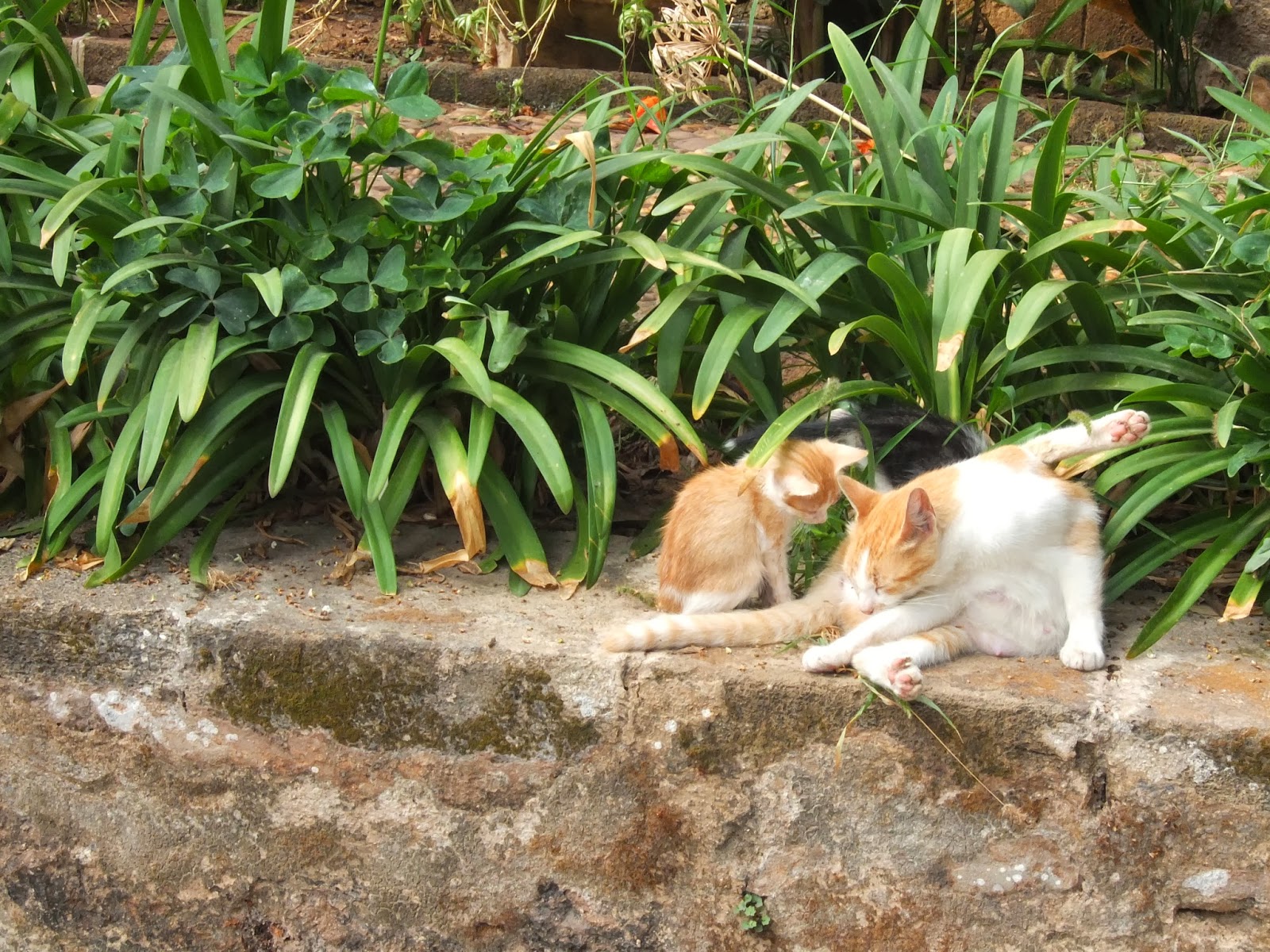
Cindy and I went to Rabat, Morocco, in September 2011.  Cindy was attending a conference, and I was in familiar role as tourist, a role I love playing, especially in places where I am virtually the only tourist.  Rabat has lots of flowers and lots of cats.  Many of the flowers and trees, if not all, we see in Mississippi.

The first several photos are of the grounds at the hotel.


Inside the Kasbah:


At the Chellah, which was once the site of the Roman city, later used by the Alhomid dynasty as a cemetery, also houses the ruins of a mosque.


Stork nests on top of the walls and column in the background.